
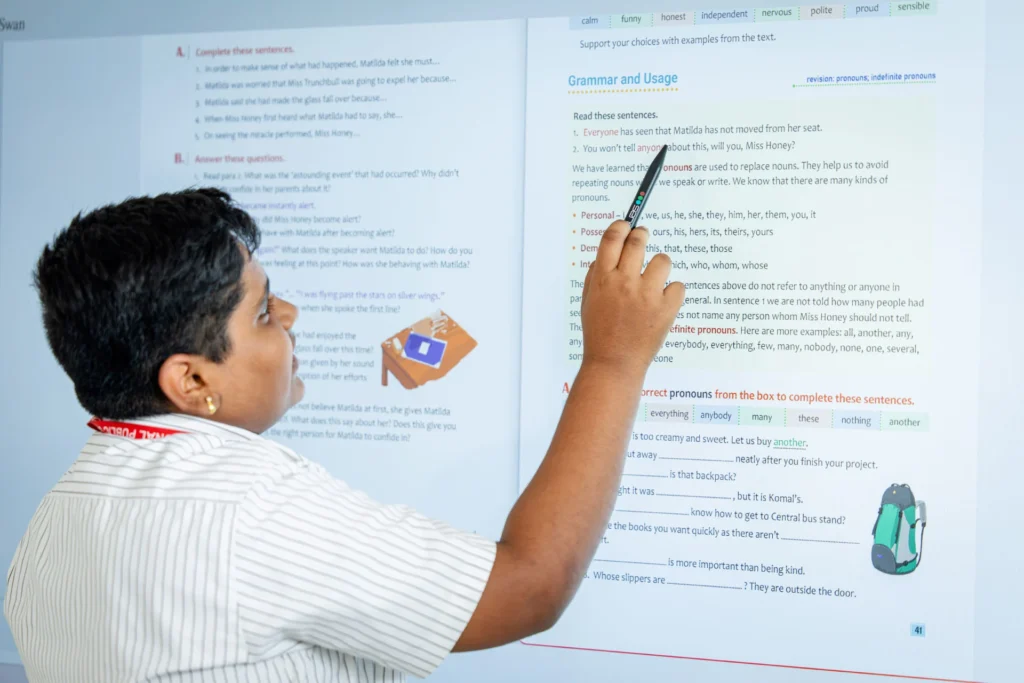
One of the prime factors that help in identifying a good school with consistently high performance is the teaching methods in education. While traditional teaching builds strong academic foundations, modern teaching brings in creativity and adaptability. The most effective education system combines both approaches, creating a balanced learning environment that prepares students for future challenges.
Introduction
The past few years have seen a considerable change in the education system with a pattern shift from chalk-and-talk classrooms to technology-driven learning environments. Today, the debate between traditional teaching and modern teaching methods is more relevant than ever.
While both traditional teaching and modern teaching emphasize different approaches, their common aim is to educate students effectively.
Traditional vs. Modern Teaching
This comparison should give you a simpler but clear understanding of the two different modes of teaching.
| Aspect | Traditional teaching | Modern teaching |
| Teaching style | More teacher-centric | More student-centric with more freedom. |
| Use of tools | Textbooks, a blackboard, and chalk | Smart boards, apps, and digital tools |
| Method of learning | More memorization | Conceptual understanding |
| Role of the student | More of a listener | More as an active participant |
| Assessment | Exams at various phases | Continued evaluation |
| Flexibility | Limited | Very flexible |
| Engagement | Not very high collectively | Extremely high with collective curiosity. |
Which Works Better?
When it comes to analyzing which of these works better, the answer may not be very convincing, as both these methods have their own strengths and limitations. The most effective method would be a blend of both. This content brings in a bit of everything that makes education a joy.
- Focuses on real-world classroom practices by considering how students respond to different learning environments.
- Modern teaching methods like experiential learning, flipped classrooms, and digital integration are based on globally accepted educational frameworks.
- The discussion follows common teaching methods that mix digital and classroom learning.
- The information provided here is unbiased, presenting both advantages and limitations of each method.
Conclusion
The advantages of modern teaching methods need to be experienced personally, more than just a literature introduction.
Hence, if you are curious about how the perfect blend of traditional and modern teaching works in real classrooms, contact us at NPS KR Puram, trusted by many as one of the best among CBSE schools with modern teaching methods, and explore how they are shaping up champions to follow.
Frequently Asked Questions
- What is the main difference between traditional and modern teaching?
Traditional teaching is teacher-centered, while modern teaching is student-centered. - Is modern teaching more advantageous than traditional teaching?
Modern teaching is more engaging, but traditional teaching provides strong fundamentals. - Why is traditional teaching still important?
It builds discipline, focus, and foundational knowledge, which are essential for academic success. - How is technology useful in modern teaching?
Technology makes learning interactive, accessible, and engaging through videos, simulations, and online tools. - How do I understand blended learning?
Blended learning combines traditional classroom methods with modern digital tools for a balanced approach.
References
- “Traditional vs Modern Education: A Comparative Study” – ResearchGate
- “The Impact of Technology on Education” – EdTech Magazine
- “Blended Learning: The Future of Education” – Harvard Education Review
- “Advantages and Disadvantages of Modern Teaching Methods” – Teach Thought
- “Why Traditional Teaching Still Matters” – Education Week




 Call Now